 Get
Get 
 We deliver


How to cook the perfect steak
There is nothing quite so fine as a perfectly moist and juicy steak, cooked to your absolute preference. Conversely, nothing is quite as disappointing as a steak which just doesn’t match your expectations. So what are the secrets of steak perfection?
Many chefs will disagree on the perfect method, and no one recipe will tell you exactly how to cook a steak depending on what size it is, and how you are cooking it, so it is down to your judgment. but there are a few key factors which will influence how your steak pans out.
Choose the best meat you can buy
Well reared beef which has been hung carefully to allow the enzymes to begin breaking down the fibres will cook so much better and taste far superior. With Dorset Meat Company steaks, you are most of the way there! You don’t need to buy the most expensive cuts, the cheaper ones can create a steak which is just as packed with flavour. To choose the perfect cut, have a look at our guide to choosing the perfect steak. (LINK)
Choose the right pan
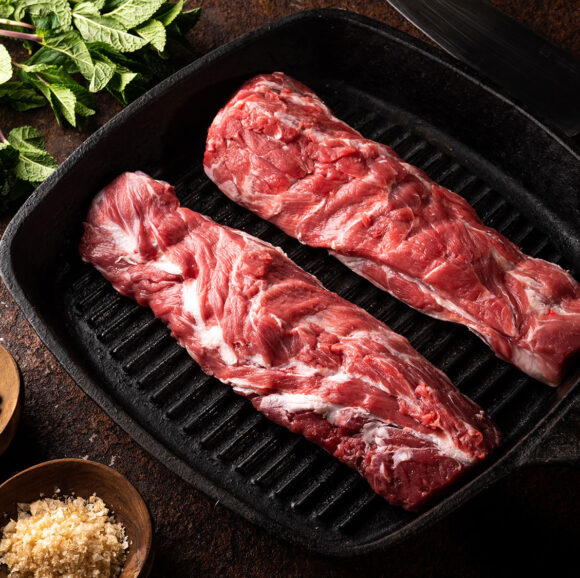
For best results, a steak should be pan fired in our opinion. Choose a pan with a heavy base for effective heat transfer, and a griddle pan will also add those distinctive caramelised scorch lines for added flavour. Make sure there is plenty of room in the pan, if you crowd it with more steak than spare surface area, the temperature will drop.
Prepare the steak
Make sure you let the steak sit unwrapped for an hour out of the fridge before cooking, so that the heat will penetrate more effectively. Make sure the surface is dry, so the meat will caramelise, rather than boil, as wet steak will struggle to form a good crispy crust.
Adding flavour
This is personal preference, you can season the steak well beforehand as per your liking, rub with garlic, or brush with thyme, or simply cook the steak as it is, and enjoy the complex flavours of the meat itself. Salt will help to build a crust, so add either before or during cooking as per personal preference.
Plan your timing and temperature
Know how long you need to cook your steak for and how you will know when it is ready, before you cook, so you can make the right call at the right time, as there will be mere minutes between the steak being too rare, or overdone.
First, you need to know how you or your diners prefer their steak, as follows;
Blue – 45°C – As rare as possible, blue steak has literally been flash fried to caramelize the outside. It will effectively be raw in the middle, but cooked on the outside.
Rare – 50°C – Cooked for a couple of minutes, about ¾ will be red with blood still oozing.
Medium rare – 55°C – Cooked for 5-7 minutes, with the meat being pinky brown in colour.
Medium – 60°C – Cooked for around 8 minutes Still juicy, but mostly brown with about ¼ pink through the middle
Well done- 70°C – Cooked for around 12 minutes, the meat is brown throughout, but without reaching the point of being too dry. This is perhaps one of the hardest to judge, as it is all to easy to leave it for too long and not notice the point at which the steak is overcooked.
Timing however doesn’t take into account the thickness of the steak, so there are two methods of testing when your steak is cooked to your liking, the finger test, and a thermometer. With the finger test, you put your thumb and forefingers together, and press on the fleshy base of your thumb. Compare the firmness with the feel of your steak. With your hand open, this fleshy part of your thumb should feel like a rare steak. Press your thumb and index finger together for medium rare (slightly springy), thumb and middle finger for medium (quite firm) , thumb and ring finger for medium well (firmer) and thumb and little finger for well done (hard).
However, using a probe thermometer is a far more accurate way of judging your steak! You can buy a good one for under £10 and they take out all of the guesswork. Simply place the probe in the centre of the steak, and ensure the internal temperature almost reaches the temperatures above. As the steak nears the chosen temperature, remove it to rest as it will still continue to cook for a few moments afterwards and reach your chosen temperature.
The pan should be preheated so any oil added is spitting, but not smoking.
Use the best fat
The amount of oil or fat generally depends on how well marbled or lean the cut is. Fillet will need more fat, while a rinded steak may need none at all. Oils without flavour work best, such as sunflower or vegetable oil, or if cooking a sirloin you can render the fat of the edge of the rind beforehand. You can also add butter if you wish, as the browning will add it’s own distinctive flavour.
Searing the steak
Searing is all about creating the Maillard reaction, which is effectively the caramelisation of the protein to create amazing flavour. The quicker a steak cooks, the less moisture it will lose. The key is to give it quick pulses, so just as it is starting to caramelise on one side, you flip it over, for even cooking. Turn it every 30 seconds or so. Frequent turning prevents either side losing too much moisture.
Resting is key!
Don’t be tempted to tuck in straight away, a steak needs time to rest, for the muscle fibres to relax, and reabsorb the moisture released within during cooking . As it relaxes, it will become more tender. Leave for 3-5 minutes, or half the time that it was cooked in.
Now serve, and enjoy the perfect steak!
Order Meat Online – Free UK Delivery Available
Shop our range of high welfare 100% grass fed meat boxes and free range poultry. Get 10% off your first order with discount code ‘welcome10‘